Kawasaki Ultra 130 DI: Crisp and Clean PWC
Kawasaki's Ultra 130 DI borrows the best from its siblings
December 17, 2001

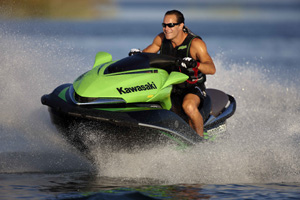
The Ultra 130 DI rides on the same crisp-handling hull as the more-powerful Ultra 150.
You'll be forgiven if you mistake the new Ultra 130 DI for an existing model. After all, we've seen most of the key features before. The deck and hull are borrowed from the Ultra 150, while the clean-burning, 130-horsepower engine is pulled from the 1100 STX DI. Together, they make the Ultra 130 DI a clean alternative for high-performance enthusiasts.
Beyond the throatier voice of the 150 and the smoother and cleaner fuel delivery on the 130 DI, most casual enthusiasts won't be able to tell much difference between the Ultra 150 and the Ultra 130 DI. Side by side, the 20-horse difference is apparent, particularly on the top end, but that will be more than made up for by the better fuel economy and cleaner operation of the 130 DI.
Power Move
Top credit for these attributes goes to the Ficht Fuel Injection used on the Ultra 130 DI's 1071-cc inline triple engine. The system uses an Engine Management Module to determine ignition timing and the precise amount of fuel to inject into the cylinders, depending on the crankshaft position, throttle position, engine, temperature, intake air temperature and atmospheric pressure. The result is a more efficient use of fuel, improving not only consumption, but also performance. You notice it particularly during acceleration. The powerband is smooth and throttle response is much crisper than standard carbureted engines.
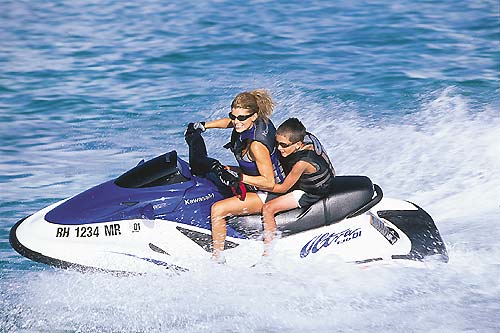
In addition to having the space for two-riders, the Ultra 130 DI has plenty of power to efficiently move them.
The Ultra 130 DI also uses nearly a third less fuel and half as much oil as a craft using carburetors. Emissions are reduced by 75 percent compared to carbureted two-stroke engines.
All in all, the engine is a good one. Its 130 horsepower is produced at 7,000 rpm. Basic specs include a bore and stroke of 80 mm by 71 mm and a compression ration of 6.8:1. Power is transferred to the water through a mixed-flow pump. Unlike the axial-flow pump used on most watercraft, which straightens out all the water going through the impeller with stator vanes, a mixed-flow pump allows some of the water to keep spinning as it exits the pump. That allows the Ultra 130 DI's pump to process more water in less time and with less overall size. Typically, there's a trade-off with mixed-flow pumps in terms of the longer time it takes to load the pump; but that isn't noticeable on the Ultra, mainly because it isn't as radical a mixed-flow design as past mixed-flow pumps.
The pump is fitted with an electric variable-trim system, with a range of angle from neutral (at the highest setting) to 10 degrees down.
Sharp Feature
The other big difference between the Ultra 130 DI and the Ultra 150 is the 130's new Smart Steering system, which allows you to steer the craft with the throttle off. The system uses a computer chip to automatically increase thrust when the handlebars are turned while the craft is revving down from a high rpm.
The idea is a good one, particularly for less experienced riders who often get into trouble because they let off the throttle while trying to avoid another boat or obstacle. However, most riders won't really notice it while underway.
Form and Functions

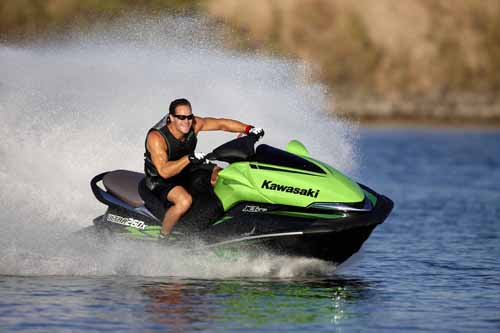
Sweeping lines give the Ultra 130 DI a sporty, aggressive appearance.
Beyond the above-noted differences, the Ultra 130 DI is almost identical to the Ultra 150. Size-wise, the 130 DI is average in size for a performance two-seater, measuring at 113.6 inches long, 44.4 inches wide and 40.5 inches tall. The hull was based in part on Kawasaki's old ZXi bottom, though it features a steeper deadrise (22 degrees) and a rounded keel. The inside of the hand-laid fiberglass hull uses bulkhead construction to keep the weight down without sacrificing strength. The deep-V design incorporates two strakes on either side of the keel, as well as a splash rail on the bow to reduce the amount of spray that reaches the driver. Two hooked sponsons are attached to the backsides of the hull.
The Sheet-Molded Compound deck is identical to the Ultra 150 except for absence of silver in the Omega color scheme and graphics. It's a fairly comfortable setup, though seat height and footwell depth don't provide as much leg room as most competitive two-seaters.
The Ultra 130 comes standard with a multifunction, digital instrument panel that includes fuel and oil levels, speedometer, tachometer, hour meter, trip meter, trim gauge and clock, and warning lights for low fuel, oil and voltage and engine and exhaust temperatures. A one-gallon glove box is included on the console, and there is a 5.5-gallon storage compartment in the bow. Other standard features include recessed bow hook, dual towing hooks in the stern, mirrors and a seat strap.
Controls are similar to what you'd find on most Kawasaki models. The fuel tank holds 15.3 gallons, and the oil reservoir holds 4.8 quarts. The fuel fill and oil fills are both conveniently located under the front hatch.
Boat specifications
| Engine type | two-stroke three cylinder with Ficht Fuel Injection |
| Displacement | 1,071cc |
| Horsepower | 130 at 7,000 rpm |
| Bore and stroke | 80.0 x 71.0mm |
| Compression ratio | 6.6:1 |
| Induction | direct injection |
| Cooling system | inducted water |
| Ignition | digital |
| Propulsion system | jet pump, mixed-flow/single-stage |
For more information
Kawasaki Motors Corp.
9950 Jeronimo Road
Irvine, CA 92618-2084
(949) 770-0400.